Fot. Centre for Advanced Studies in the Renaissance (CESR)
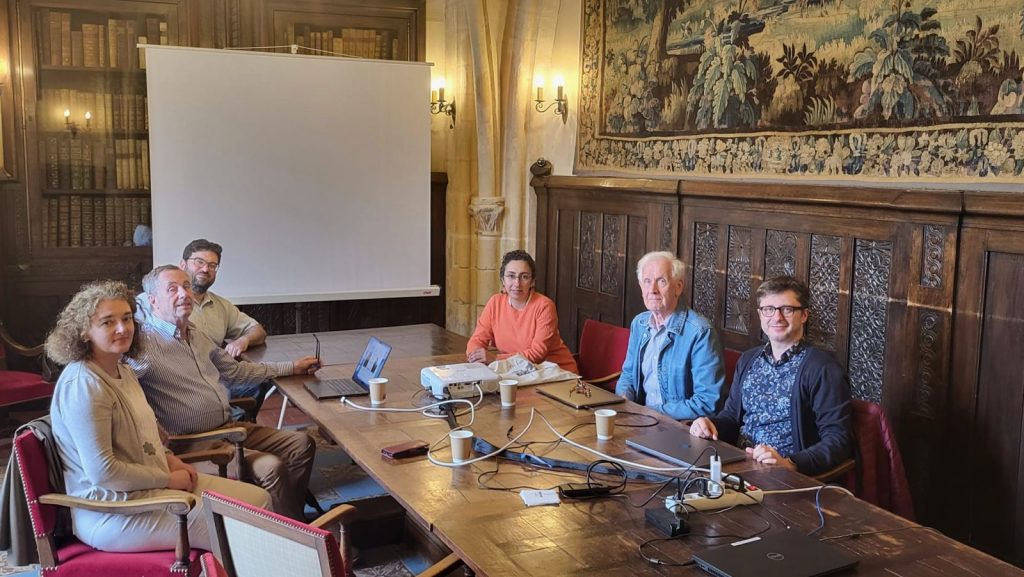
From the left: Kateryna Schöning (University of Vienna – AT), John Griffiths (University of Melbourne – AU), David M. Weigl (University of Music and Performing Arts Vienna – AT), Ailin Arjmand (CESR, University of Tours – FR), Tim Crawford (Goldsmiths, University of London – UK), Grzegorz Joachimiak (University of Wrocław)
Meeting of the ‘Tablature and Technology for Tomorrow’ consortium in Tours
From 27 to 30 April 2026, the Centre d’Études Supérieures de la Renaissance in Tours hosted the first meeting of the international research consortium ‘Tablature and Technology for Tomorrow’, which is being carried out as part of the Le Studium Loire Valley Institute for Advanced Studies programme for the years 2026–2027.
The event was attended by Dr Grzegorz Joachimiak, head of the Centre from Digital Musicology at the University of Wrocław and a member of the consortium. The project, coordinated by Philippe Vendrix (CESR, University of Tours) and Ailin Arjmand (CESR, University of Tours), brings together researchers from Austria, the United Kingdom, Australia and Poland who specialise in repertoires recorded in tablature notation from around 1500 to 1750.
The first meeting served as an opening event, but was also a time for reflection – the participants drew on over thirty years of tradition in tablature research, recalling a meeting held in 1992 at the same venue which addressed similar issues. A comparison of these two occasions clearly demonstrated how significantly research opportunities in this field have changed.
The discussions confirmed that research into tablature is currently entering a new phase. A repertoire that for a long time remained difficult to access and marginalised in music historiography can now be analysed using digital musicology tools, such as the MEI standard, OMR techniques and Linked Open Data solutions. Close international cooperation and the integration of existing resources play a significant role in this.
Dr Joachimiak’s involvement in the consortium’s work is a key aspect of the University of Wrocław’s participation in international research projects, and also contributes to the development of our Centre for Digital Musicology in research into historical notation and digital methods. The next consortium meeting is scheduled for October 2026.